
A Shipment Can Arrive Within Range and Still Have Had an Excursion
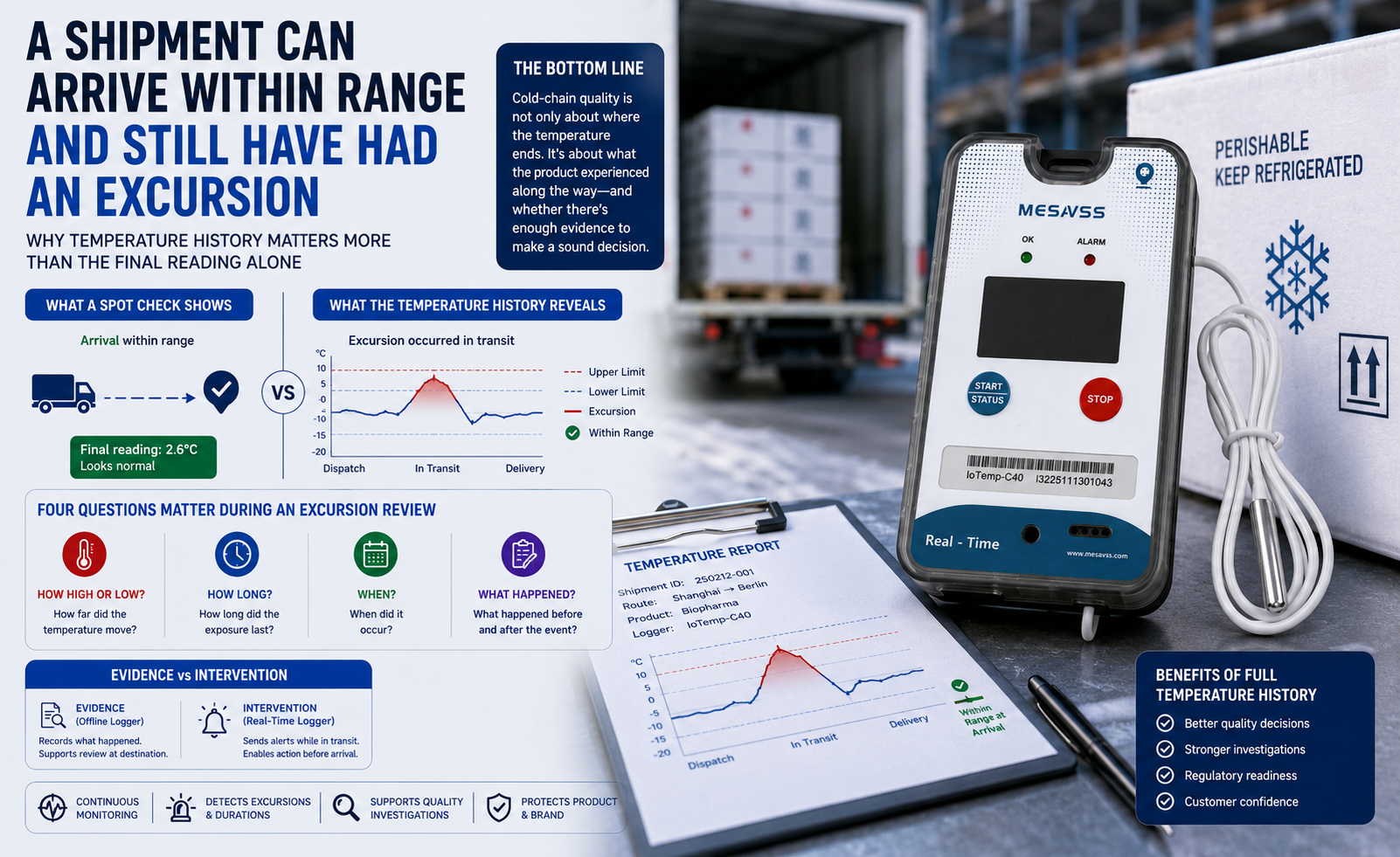
A shipment can arrive within the required range even if it experienced a temperature excursion earlier in the route. Refrigeration can pull the measured temperature back toward target before the receiving check. What disappears is not necessarily the evidence — unless no device was recording it.
Recovery does not erase exposure
Imagine a temporary event: a refrigeration interruption, a long loading stop or repeated door opening. The air temperature may rise and then fall once cooling resumes. At delivery, a spot check can look normal. But the product has still experienced a period of different thermal conditions. Whether that exposure matters is product-specific and should be assessed against approved stability information or the relevant quality procedure.
Four questions matter during an excursion review
A useful review should establish four things: how high or low the temperature moved, how long the exposure lasted, when it occurred, and what happened immediately before and after it. A continuous logger helps reconstruct that sequence. Real-time systems can add location, alerts and other events, but the basic requirement is the same: preserve the history.
Why 'temperature back to normal' is not a disposition decision
Quality teams should not assume that a recovered temperature automatically makes a shipment acceptable, and they should not assume that every brief excursion means the product is unusable. The correct decision depends on the product's approved storage conditions, excursion limits, stability information and internal procedures. Monitoring provides evidence; it does not replace the quality decision.
The difference between evidence and intervention
An offline data logger is mainly an evidence tool. It records what happened and supports review at destination. A real-time logger adds the possibility of intervention: if an alert is received while the shipment is still moving, the carrier or control team may be able to investigate, adjust the route, check the refrigeration system or escalate the event before arrival.
A practical example
If a shipment's temperature rises during a long stop and later returns to range, the final dock reading may show nothing unusual. A continuous curve, however, can show the start of the event, its duration and the recovery pattern. That information is far more useful for an investigation than a debate based on memory or assumption.
Takeaway
Cold-chain quality is not only about where the temperature ends. It is about what the product experienced along the way — and whether there is enough evidence to make a sound decision.