
Real-Time Temperature Monitoring for Fresh Produce Shipments
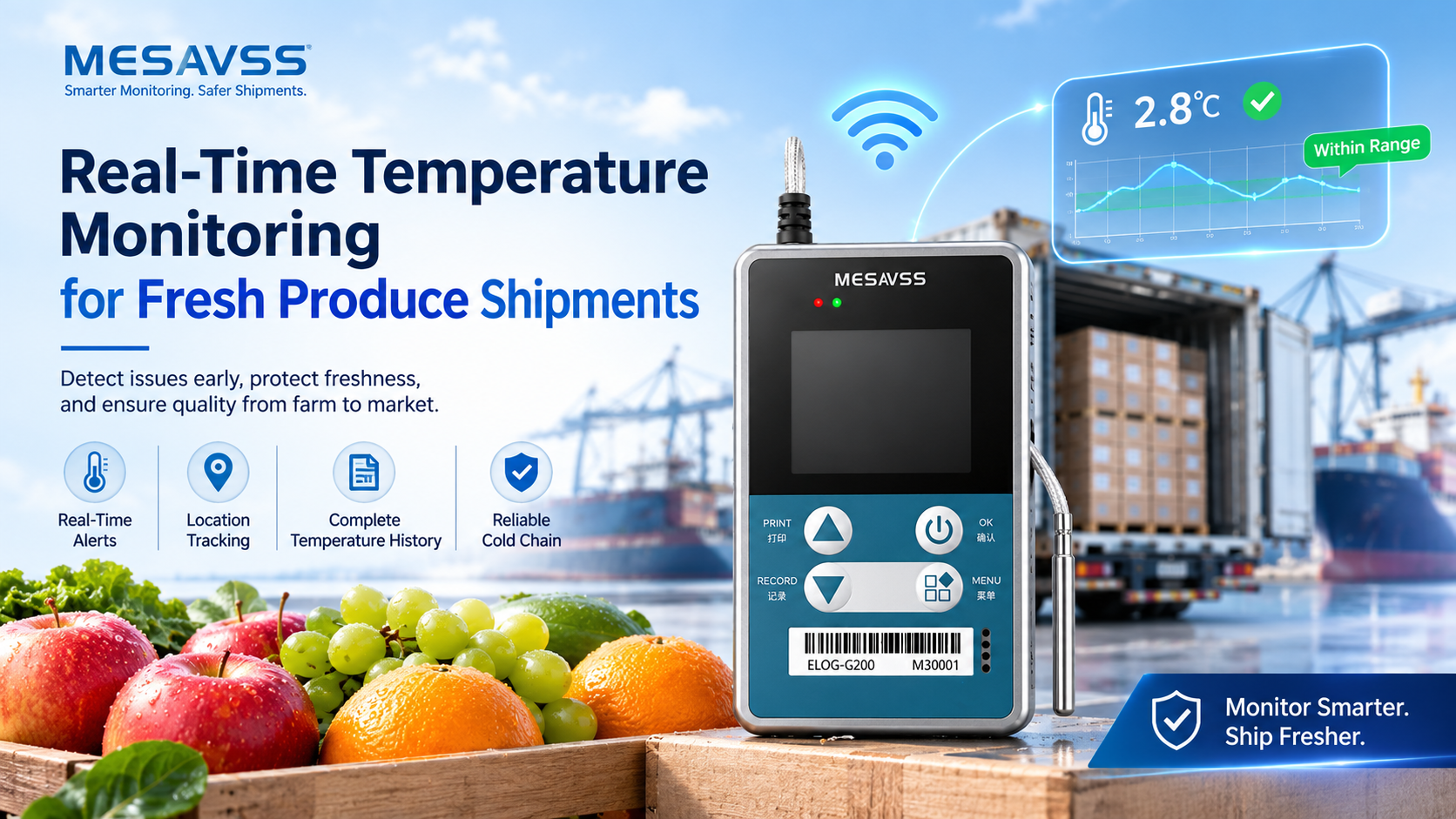
Fresh produce does not wait for the shipment report
A temperature report downloaded at destination can explain why a shipment arrived with reduced shelf life. It cannot give an exporter back the days that were lost in transit.
That is why produce companies are paying more attention to real-time temperature monitoring. The objective is not to replace every USB logger or to watch a dashboard continuously. It is to identify the small number of shipments that require attention while there is still a realistic chance to protect the cargo.
Fresh produce continues to respire after harvest. Its quality changes with time, temperature, humidity, airflow, maturity and handling. A shipment can remain technically “cold” and still lose commercial life because it was loaded warm, exposed during a handover, blocked from airflow, or carried under a temperature setting that did not match the commodity.
Real-time data makes these conditions visible earlier. It does not stop deterioration by itself, but it changes when the exporter learns about the problem.
Where freshness is commonly lost
The journey begins before the container door closes. Field heat that has not been removed by effective precooling becomes part of the transport load. A reefer is designed mainly to maintain cargo temperature, not to pull down large quantities of warm produce quickly.
Risk then accumulates at several points:
· loading while the dock or cargo is too warm;
· incorrect reefer setpoint or operating mode;
· poor airflow caused by pallet arrangement or overloading;
· extended dwell at a terminal or border;
· equipment or power interruption;
· door opening during inspection or cross-docking;
· delayed delivery after the container reaches port;
· mixed commodities with incompatible temperature or ethylene requirements.
A conventional logger records these events for later review. A real-time device can transmit temperature, location and, depending on the model, additional condition data while the shipment moves through areas with network coverage.
What “real time” should mean in practice
Real-time monitoring does not necessarily mean a new reading appears every second. Cold chain teams normally configure a sampling interval, an upload interval and an alarm rule. These three settings serve different purposes.
The device may measure temperature every few minutes, transmit a batch of readings less frequently, and send an alert when a defined condition is met. This approach balances visibility, battery life, data cost and operational urgency.
For produce, a useful alert should consider both temperature and time. A one-minute rise during loading may not justify escalation. A sustained deviation during a long road leg may require immediate contact with the carrier. The threshold must reflect the commodity, packaging, route and response plan—not a universal “fresh food” setting.
Air temperature is not the same as product temperature
One of the most common interpretation errors is to treat a logger reading as the exact temperature of every carton.
An ambient sensor responds to the air surrounding the device. Product pulp changes more slowly because the produce has thermal mass. A short rise in return-air temperature may show a door opening or refrigeration cycle without proving that the fruit experienced the same change. Conversely, warm product loaded into a cold container may remain warm internally even when the surrounding air appears acceptable.
Device placement therefore matters. A tracker beside the door may reveal handling exposure but may not represent the center of a pallet. A device buried inside packaging responds differently and may have limited cellular signal. For higher-risk shipments, teams may combine reefer data, one or more cargo-level devices, and pulp-temperature checks at loading and receiving.
From alert to action
The most important part of a real-time system is not the map. It is the response procedure.
Before a shipment departs, the exporter should define:
1. who receives an alert;
2. who verifies whether it is genuine;
3. who may contact the carrier or consignee;
4. what action is possible at sea, on the road or at a terminal;
5. how the event and response will be documented.
Possible actions include confirming the reefer setpoint, asking a driver to inspect the unit, prioritizing a container for power connection, arranging an earlier delivery slot, or preparing the receiver to inspect and segregate the cargo. Sometimes no physical intervention is possible. Even then, earlier information can help the commercial and quality teams plan receiving, sampling and customer communication.
Where USB loggers still make sense
Real-time monitoring is not automatically the best economic choice for every carton or lane.
Single-use USB loggers remain appropriate when the cargo value is moderate, the route is stable, connectivity is poor, and the main requirement is an arrival report. They are also useful as an independent record inside the shipment.
Real-time devices provide more value when the cargo has a short remaining life, the route includes multiple handovers, delay is common, the shipment value is high, or the team can act on alerts. Many exporters use a tiered policy: passive loggers for routine loads and real-time devices for high-risk commodities, new lanes, claims-prone carriers or premium customers.
Building a useful lane history
The value of connected monitoring increases when data is reviewed across many shipments. One temperature curve may explain a single event. Twenty or fifty shipments on the same lane can reveal a pattern.
Exporters can compare:
· time from packing to precooling;
· loading and terminal dwell;
· different carriers or sailing schedules;
· frequency and duration of excursions;
· location of repeated handover delays;
· remaining shelf life on arrival;
· claims and rejection outcomes.
This turns monitoring from a defensive record into a lane-improvement tool. It can support discussions about packaging, precooling, carrier performance and delivery scheduling with evidence rather than assumptions.
Choosing a device for produce exports
The selection should begin with the shipment, not the product catalogue. Confirm the required temperature range, trip duration, reporting countries, network coverage, airline or vessel restrictions, sensor position, alarm recipients and data-retention needs.
MESAVSS real-time devices, including options within the ELOG and ILOG portfolios, can support shipment-level temperature and location visibility through a cloud platform. The correct configuration depends on the lane and cargo. A trial should reproduce the intended placement and route rather than test the device only on an office desk.
Conclusion
The commercial question is no longer only whether an exporter can prove what happened after delivery. For high-risk produce, it is whether the team can recognize a developing problem early enough to respond.
Real-time temperature monitoring cannot compensate for poor precooling, unsuitable packaging or weak carrier procedures. Used within a disciplined cold chain process, however, it provides something a destination report cannot: time.
Frequently asked questions
Can real-time monitoring prevent produce spoilage?
No. It can detect conditions associated with quality loss and support earlier action. Effective precooling, packaging, airflow and transport control remain essential.
Will the device transmit while a container is at sea?
Cellular transmission may be unavailable offshore or inside a metal container. A suitable device should continue recording locally and upload stored data when connectivity returns.
Should the sensor measure air or pulp temperature?
They answer different questions. Ambient measurements show the environment around the device; pulp checks indicate product temperature. A monitoring plan may require both.
Does every produce shipment need a real-time tracker?
No. Use risk, cargo value, shelf life, route complexity and intervention capability to decide.
What is the best reporting interval?
There is no universal interval. Shorter intervals improve event detail but use more power and data. Configure sampling and uploading around trip length and response needs.
Can one device represent an entire reefer container?
Not always. Temperature varies by location. Placement should reflect the monitoring objective and known hot or cold spots.