
Why Temperature Data Loggers Are Essential for Modern Cold Chain Management
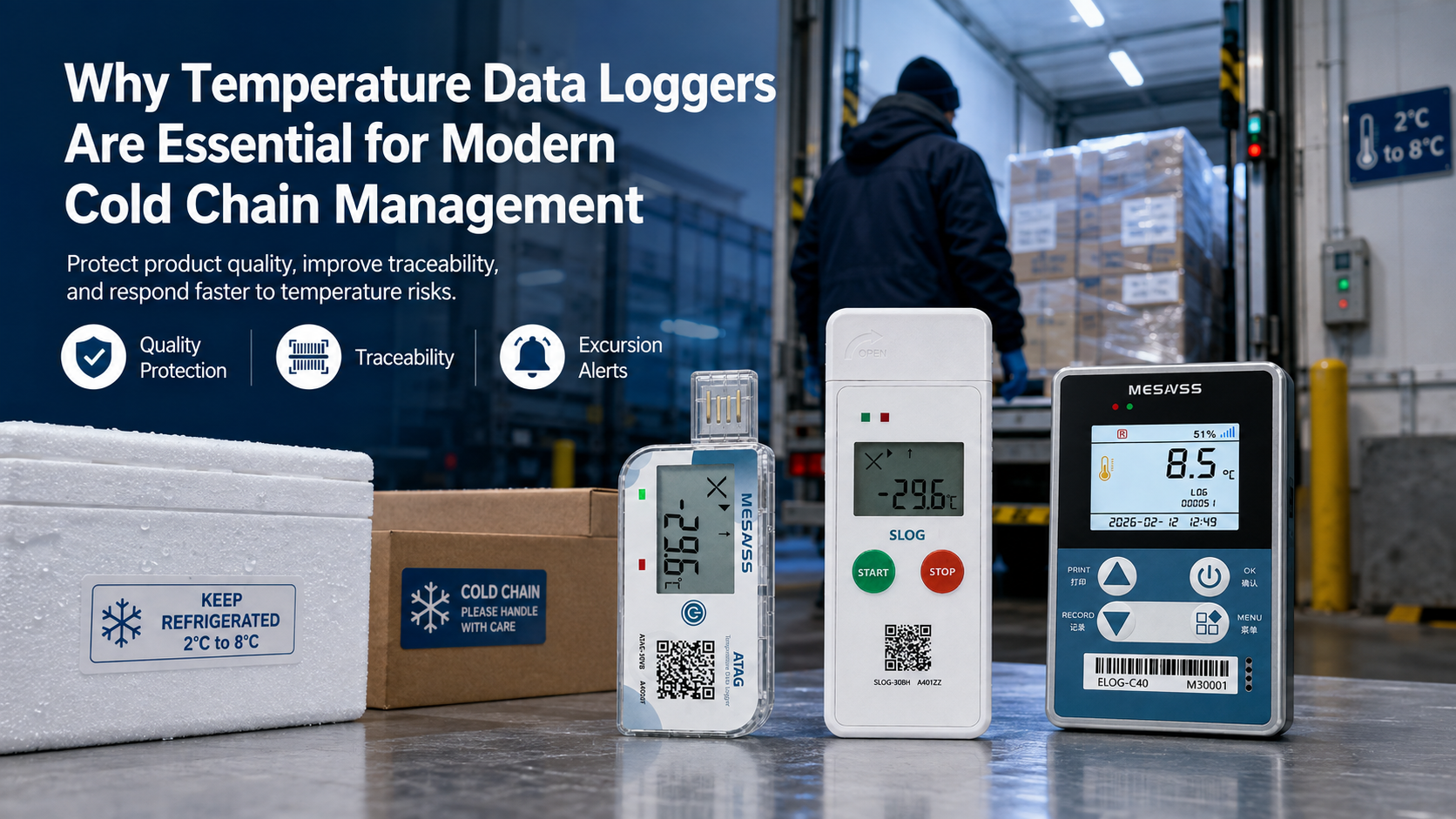
A refrigerated truck, insulated box or reefer container can maintain a set temperature. It cannot, by itself, prove what happened to the cargo at every stage of the journey.
That distinction matters. Modern cold chain management is no longer judged only by whether cooling equipment was running. Importers, quality teams, customers and auditors increasingly need evidence that temperature-sensitive products remained within their defined limits—and a clear process for dealing with any exception.
Temperature data loggers provide that evidence. They create a time-stamped record of the conditions experienced by a shipment or storage area. Used properly, that record supports receiving decisions, excursion investigations, claims, compliance and improvement across the supply chain.
Their value, however, is often overstated in one important way: a logger does not prevent an excursion simply because it is present. It becomes useful only when the device, its placement, its settings and the response process match the actual risk.
The short answer
Temperature data loggers are essential in modern cold chain management because they turn an invisible condition—temperature exposure over time—into verifiable data. This allows a business to confirm transport conditions, detect excursions, make evidence-based release decisions, assign responsibility at handover points and improve future shipments. USB loggers are well suited to post-shipment verification, Bluetooth loggers simplify local data access, and real-time loggers can support intervention while a shipment is still moving.
Cold chain control and cold chain evidence are not the same thing
Refrigeration controls the environment. Monitoring verifies the result.
A vehicle display may show the return-air temperature inside the refrigerated compartment, but the product may experience different conditions. Pallets near a door can be exposed to warm air during unloading. Cartons close to an evaporator may face local cold spots. A sensor installed in the truck does not necessarily represent the temperature inside every package.
This is why a temperature set point, a driver’s statement or a refrigeration unit record cannot always answer the question that matters most:
What temperature did this shipment experience, and for how long?
A logger placed with the cargo provides a shipment-level record. It does not replace refrigeration controls, qualification or good handling practices. It closes an evidence gap between the intended condition and the condition actually experienced.
Seven reasons data loggers have become operationally important
1. They make temperature exposure traceable
Cold chains involve repeated transfers: production to warehouse, warehouse to carrier, carrier to airport or port, terminal to destination agent, and finally to the consignee. Each handover creates a period in which responsibility may be unclear.
A time-stamped temperature history helps teams compare an excursion with pickup, loading, customs, flight, delivery or unloading events. The data may not identify the cause on its own, but it narrows the investigation and replaces guesswork with a usable timeline.
2. They support better product-disposition decisions
A single high or low reading does not automatically mean a product must be rejected. The decision may depend on the product specification, excursion temperature, exposure duration, packaging qualification, stability data and the shipper’s quality procedure.
A logger preserves the temperature-versus-time record needed for that assessment. Without it, the receiving team may be forced into one of two poor decisions: accept a shipment without enough evidence or reject it purely as a precaution.
The logger does not decide whether the goods are safe or usable. It supplies evidence to the authorized person or quality team that does.
3. They strengthen compliance and audit readiness
For temperature-sensitive pharmaceuticals, food and other controlled products, organizations are generally expected to define required conditions, monitor them where appropriate, investigate deviations and retain relevant records. The exact obligation depends on the product, market and applicable quality system.
A suitable logger can create a reviewable record containing measurement times, temperatures, alarm limits and device information. That record is far more useful when it is supported by calibration, controlled configuration, device identification, data-retention rules and written excursion procedures.
It is therefore misleading to treat “using a logger” and “being compliant” as the same thing. Compliance is a system; the logger is one evidence-generating component within it.
4. They help separate real risk from assumptions
Cold chain teams often rely on familiar routes, experienced carriers or qualified packaging. These controls matter, but operating conditions change. Seasonal weather, customs delays, new hubs, mixed loads and different loading practices can alter the thermal risk.
Logger data shows whether the process continues to perform under real shipment conditions. Over multiple shipments, teams can compare routes, lanes, carriers, pack-out designs and dwell locations. This turns monitoring from a pass/fail exercise into a source of operational intelligence.
5. They improve claims and accountability
When damaged cargo arrives, commercial disputes often begin with incomplete evidence. The shipper may blame the carrier; the carrier may point to packaging; the consignee may report that the goods were already warm when received.
A credible temperature record can help establish when conditions changed. For stronger evidence, the logger record should be matched with shipment milestones, proof of delivery, packaging records and handling documentation. A temperature chart alone rarely proves legal responsibility, but it can materially improve the quality of the investigation.
6. Real-time models can enable intervention—not merely documentation
Traditional USB loggers are normally read after arrival. They are effective when the goal is route verification, receiving inspection or a downloadable PDF report.
Real-time devices add connectivity and can transmit temperature and, depending on the device, location or other sensor data during transit. When alerts reach someone who has authority to act, the team may be able to contact a carrier, correct a set point, move a shipment, replenish coolant or prepare the destination team before arrival.
The important phrase is “may be able to.” Real-time visibility is not the same as real-time control. If alert thresholds are poorly configured, network coverage is intermittent or nobody owns the response, the system produces notifications without reducing risk.
7. They create a feedback loop for continuous improvement
One shipment report answers, “What happened?” A structured collection of reports can answer more valuable questions:
Which routes have the most frequent excursions?
At which handover do delays occur?
Are low-temperature alarms linked to logger placement?
Does one packaging configuration perform better in summer?
Are repeated alarms genuine product risks or unsuitable thresholds?
This is where temperature monitoring becomes part of cold chain management rather than a box placed inside a shipment.
What type of logger does the operation actually need?
The most advanced device is not automatically the best choice. Selection should follow the decision that the data must support.
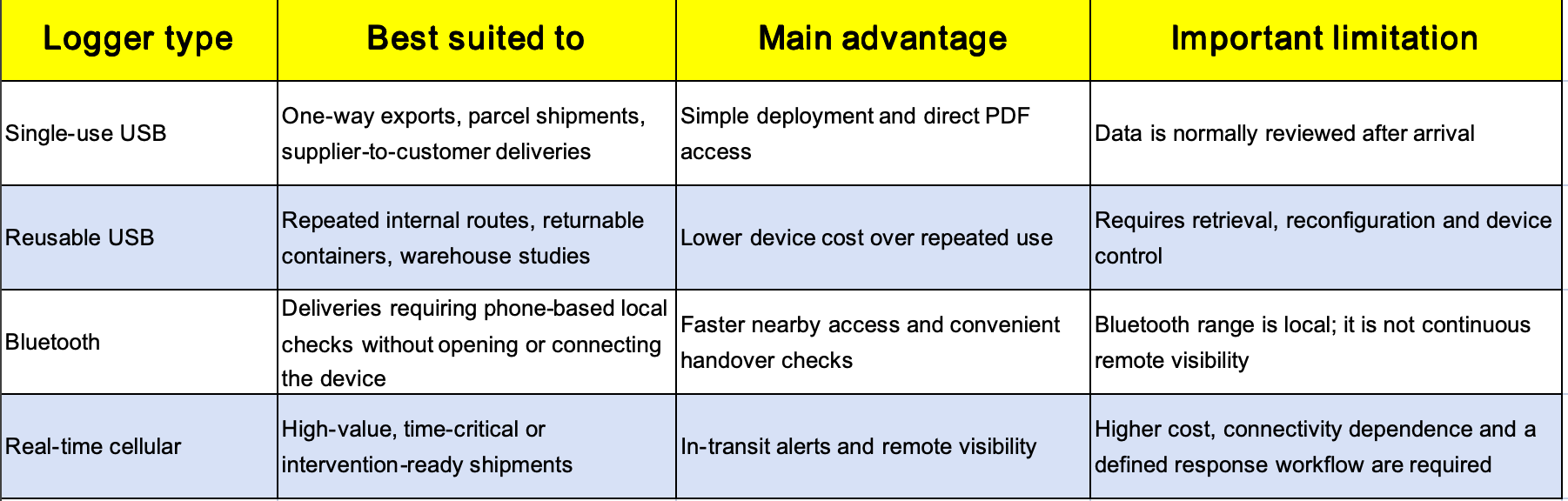
Before selecting a model, define the temperature range, accuracy, logging interval, trip duration, start delay, alarm rules, report format, calibration requirement, battery limitation, connectivity environment and data-retention process.
The mistakes that make logger data unreliable
Buying a logger is easy. Designing a defensible monitoring process is harder. Several common errors can undermine the result:
Poor placement
A logger placed directly beside a coolant pack may record the pack’s local temperature rather than the representative product environment. A device fixed near a door may capture handling exposure that the centre of the load did not experience. Placement should reflect the question being asked and, for validated shipments, follow the approved pack-out or monitoring procedure.
Unsuitable logging intervals
A very long interval can miss short events. An unnecessarily short interval consumes memory and may create a noisy report without improving the decision. The interval should be selected according to shipment duration, thermal response, product risk and investigation needs.
Alarm limits without time logic
Some products require action after any threshold breach; others are assessed using both temperature and duration. If a device is configured with limits that do not reflect the approved specification, it can create false alarms or conceal relevant exposure.
Missing device control
An unidentified logger, an incorrect time zone, an expired calibration status or a report that cannot be linked to the shipment weakens traceability. Device serial number, shipment ID, configuration and calibration status should be controlled where the risk demands it.
No response owner
This is the most serious failure. A business may collect thousands of temperature readings yet have no rule for who reviews them, how quickly, or what happens after an alarm. Data without ownership becomes an archive, not a control.
From device deployment to a working monitoring process
A practical process can be built around six questions:
What must remain within limits? Define the product’s approved temperature conditions and relevant duration criteria.
Where can control fail? Map loading, storage, transport, customs, transfer and delivery risks.
What evidence is needed? Decide whether the objective is post-trip verification, local handover checking or live intervention.
How should the device be configured and placed? Establish interval, delay, thresholds, time zone, device ID and placement.
Who reviews and acts on the data? Assign responsibility for normal release, alarms, escalation and investigation.
How will the results improve the next shipment? Trend excursions by route, carrier, season, product and process stage.
This framework also prevents overinvestment. A low-risk, qualified domestic lane may not need a cellular logger on every carton. A high-value international pharmaceutical shipment may justify real-time monitoring, but only if the organization can act on the alerts.
Where MESAVSS temperature monitoring fits
MESAVSS provides temperature monitoring options for different levels of cold chain visibility rather than forcing every shipment into one device type.
ATAG-30 single-use USB logger: for straightforward shipment records and PDF reporting at destination.
SLOG series reusable logger: for repeat routes, reusable packaging and operations that can recover and manage devices.
CLOG-90: for ultra-low-temperature and dry-ice applications that require an appropriate low-temperature measurement range.
ILOG series: for connected single-use shipment monitoring.
ELOG series: for reusable real-time monitoring where remote visibility and alerts form part of the operating process.
The correct choice depends on more than temperature range. Shipment value, route risk, access to the device, report requirements, return logistics, connectivity and the ability to respond should all influence selection.
A logger is indispensable only when the data changes a decision
Temperature data loggers have become central to cold chain operations because modern supply chains need proof, not assumptions. They provide the missing history between dispatch and receipt and help teams investigate exceptions with far greater precision.
But the device is not the management system. A logger creates value when its data leads to a clear decision: release the shipment, quarantine it, investigate an excursion, support a claim, correct a route weakness or prevent the same failure next time.
That is the real shift in modern cold chain management—from recording temperature as a formality to using temperature evidence as an operational tool.