
USB, Bluetooth or Real-Time Temperature Logger: Which One Do You Need?
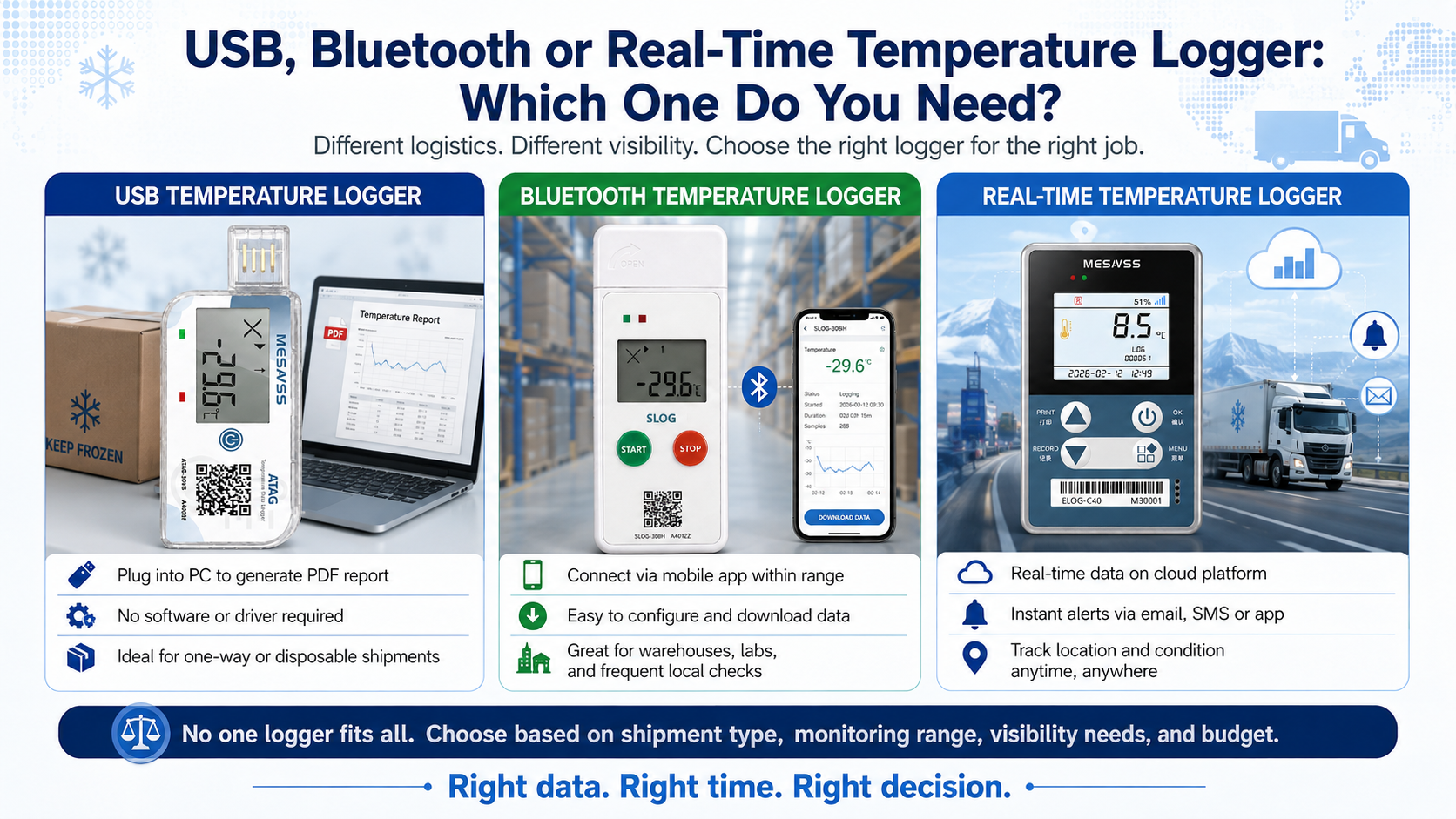
Choose USB when the record is needed at the destination, Bluetooth when nearby mobile access removes receiving friction, and cellular real-time monitoring when an alert can trigger action during transit. These technologies are not a simple good-better-best ladder. They solve different timing and workflow problems, and connected monitoring still needs local memory for periods without network coverage.
The real difference is when and where data becomes useful
All three categories can record temperature. Their main difference is access. USB makes the record available after physical receipt. Bluetooth provides local wireless access within short range. A cellular device sends selected data to a remote platform while cargo is moving.
That timing changes the business outcome. Post-trip data supports acceptance, audits and claims. In-transit data may support intervention. Paying for earlier visibility is rational only if the organisation is prepared to use it.
USB temperature loggers: simple destination evidence
A USB logger stores readings internally. At destination, the receiver connects it to a computer and opens an automatically generated PDF or CSV file, depending on the model. No mobile network is required during the journey.
USB is strong for routine one-way shipments, broad customer networks and locations where the receiving team needs a portable report. Its limitation is equally clear: the shipper normally cannot see a developing excursion before arrival.
Bluetooth temperature loggers: local access without a cable
Bluetooth allows a nearby phone, tablet or gateway to retrieve data. It can simplify checks at loading, handover and receipt, particularly when opening packaging or finding a computer is inconvenient. It can also support configuration and repeated use, depending on the device.
Bluetooth is short range. A phone hundreds of kilometres away cannot communicate directly with the logger. Remote visibility requires a gateway or another connected path. Buyers should also test app availability, permissions, user accounts, data export and whether the workflow is acceptable at customer sites.
Real-time cellular loggers: remote visibility and alerts
A real-time logger combines local sensing and storage with cellular communication and, often, location services. The platform can display current conditions, route progress and alarms. This is useful when teams can contact a carrier, correct a reefer setting, move a shipment, add coolant or accelerate clearance.
“Real time” does not mean uninterrupted second-by-second transmission everywhere. Aircraft restrictions, network coverage, roaming, underground facilities, battery strategy and configured upload intervals affect availability. The logger should continue recording locally and retransmit stored data after connectivity returns.
A decision table
Choose USB for low-friction proof at destination and cost-sensitive high-volume shipments. Choose Bluetooth when nearby reading or configuration materially improves operations. Choose real-time cellular for high-value cargo, complex handovers, long routes or lanes where early alerts can prevent loss.
Hybrid portfolios are normal. A company may use USB for routine seafood exports, Bluetooth for warehouse checks and cellular monitoring for critical pharmaceutical or high-value produce shipments.
Five questions that expose a poor technology choice
Who needs the data, and at what time? Can that person access the required computer, phone, app or platform? If an alert occurs at 02:00, who owns it? What intervention is genuinely possible? What happens when there is no signal?
If the answers are vague, the technology decision is premature. The monitoring workflow should be designed before the connectivity tier is purchased.
Data continuity matters more than a perfect signal
Cold-chain routes contain tunnels, remote highways, airports, metal containers and underground docks. Temporary disconnection is expected. The critical design question is whether measurement continues independently of transmission.
Local memory, time synchronisation, breakpoint recovery and automatic retransmission protect the complete history. The platform should distinguish between “no new transmission” and “no temperature record”; they are not the same event.
Hidden cost and control considerations
USB may require manual collection and email handling. Bluetooth may require app support and compatible phones. Cellular monitoring may add platform subscriptions, data service, device activation, charging and alert management. Security, user access and record retention also become more important as data moves to the cloud.
Compare the end-to-end process rather than the device price. The correct choice reduces total uncertainty and manual effort without adding a system the team cannot operate.
How MESAVSS maps the three workflows
MESAVSS USB models provide automatic destination reports; Bluetooth-enabled models support convenient nearby access; ELOG real-time models provide connected temperature and route visibility with local data storage. The precise choice depends on temperature range, trip length, reporting needs, airline or network constraints and escalation capability.
A pilot should include a weak-signal segment and a real receiving user. That test reveals more than a feature demonstration.