
What Causes Temperature Excursions During Transportation?
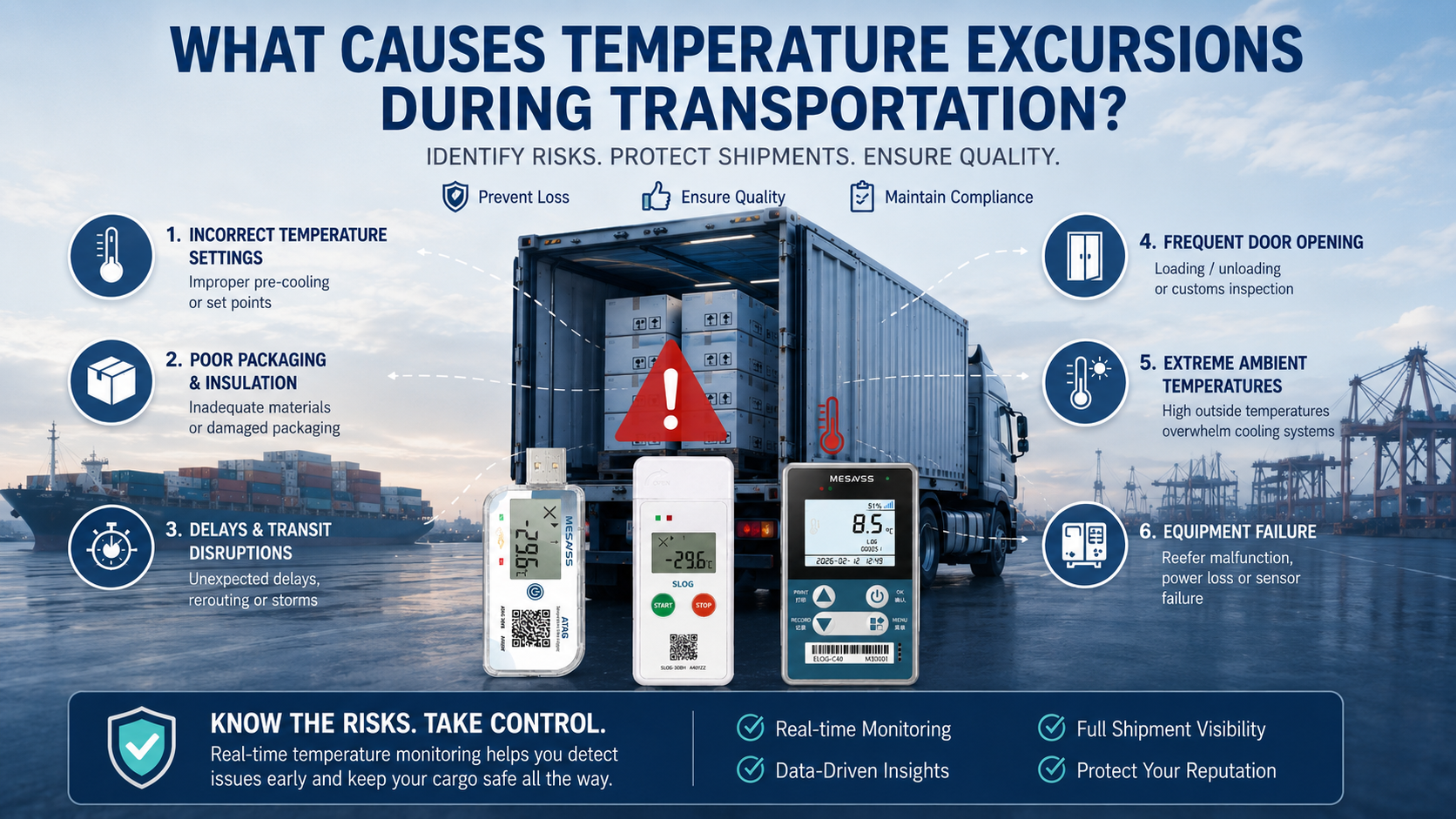
Most transport temperature excursions originate from one or more of six control failures: incorrect pre-conditioning, inadequate packaging or loading, refrigeration problems, prolonged handovers, extreme ambient exposure, and process or configuration errors. A logger identifies when and where the deviation developed, but root-cause analysis must combine the data curve with shipment events, packaging design, equipment records, and handling evidence.
An excursion is an event, not yet a root cause
A temperature excursion occurs when monitored conditions move outside the specified range. The alarm tells the quality team that a rule was met; it does not explain why. Treating every high-temperature alarm as a “carrier failure” leads to weak investigations and repeated losses.
Start by preserving the original report and shipment timeline. Confirm the product specification, logger configuration, time zone, placement and whether the alarm is based on a single, consecutive or cumulative rule. Then reconstruct what happened around the first deviation.
1. Product or packaging was not conditioned correctly
A refrigerated truck or insulated box is designed to maintain an established condition, not always to pull a warm product rapidly into range. Loading warm cargo into a pre-cooled vehicle can create a long downward curve that looks like refrigeration failure. Incorrectly conditioned gel packs can cause the opposite problem and freeze sensitive products.
Check product loading temperature, coolant conditioning records, pack-out time, quantity and orientation. A deviation that begins immediately after activation often points to preparation or placement rather than a mid-route equipment fault.
2. Packaging was not qualified for the real lane
Packaging performance depends on payload, ambient profile, duration, opening events and assembly. A solution qualified for a 48-hour moderate route may fail during a 72-hour customs delay or heatwave. Air gaps, missing insulation, incorrect coolant quantity and payload changes can reduce performance.
Qualification should reflect worst credible conditions, not the published transit time alone. Use seasonal profiles and add delay margin where the lane has recurring uncertainty.
3. Refrigeration or power failed
Reefer set-point errors, sensor faults, blocked airflow, low refrigerant, doors that do not seal, loss of external power and generator failure can create sustained deviations. Overloading and poor pallet arrangement can also prevent air circulation even when the unit is running.
Compare the cargo logger with reefer controller data, fuel or power records, door events and maintenance history. A smooth sustained rise may support a loss-of-cooling hypothesis; repeated cycles may indicate control or airflow problems. The curve is evidence, not a diagnosis by itself.
4. Handover and dwell time became longer than planned
Cargo is vulnerable when responsibility changes: from loading dock to truck, from truck to airport, from airline to ground handler, from port to customs, or from carrier to consignee. Shipments can sit in staging areas while documents, equipment, or staff catch up.
These failures often appear as a rise that starts during a known location stop. Real-time location and temperature data can shorten the investigation and, where escalation is possible, prompt movement to a controlled area before exposure becomes critical.
5. Doors, inspections and partial unloading exposed the load
Every door opening exchanges conditioned air with the environment. Multi-stop distribution, customs inspection and slow unloading can create repeated spikes. Cargo nearest a door may experience a different profile from cargo in the centre.
Short air-temperature spikes do not always mean the product reached the same temperature. Evaluate duration, position, packaging and product thermal mass. Avoid dismissing them automatically: repeated exposures may accumulate or indicate a weak handling process.
6. Logger configuration or placement created misleading evidence
Wrong alarm limits, no start delay, an incorrect time zone, premature activation, or a logger touching coolant can create an alarm that does not represent the intended monitoring point. A logger placed outside the insulated system measures a different environment from one placed with the payload.
Verify the device ID and configuration before investigating the logistics chain. If the monitoring setup was wrong, document it as a process deviation; do not edit or discard inconvenient data.
7. Extreme weather exceeded the operating margin
Heatwaves, freezing weather, and direct solar exposure can overwhelm packaging or increase recovery time after a door opening. Seasonal route changes matter: the same lane can behave differently in January and July.
Use lane history to identify seasonal risk, qualify packaging against credible ambient profiles, and position shipments away from known heat sources where operations permit. Weather is foreseeable risk in many lanes, not an adequate final root cause.
How to read the shape of an excursion
An immediate deviation may indicate loading temperature, start delay or coolant contact. A gradual monotonic rise can suggest declining thermal protection or loss of cooling. Repeated sharp spikes may align with doors or handovers. A flat line or abrupt impossible step may indicate sensor or placement issues.
These patterns are hypotheses. Correlate them with timestamps, route stops, door records, reefer data, photos, and staff statements. Root-cause analysis is strongest when independent evidence agrees.
A five-step response
Quarantine or hold the affected goods according to procedure; preserve the original record; verify configuration and chronology; assess exposure against product-specific acceptance or stability information; investigate root cause and implement corrective and preventive action.
Do not release or reject solely from a generic blog threshold. WHO guidance for time- and temperature-sensitive pharmaceutical products states that unacceptable excursions should be evaluated for their effect on the product. The product owner’s approved process governs disposition.
Prevention priorities
Standardise pre-conditioning and pack-out; qualify packaging and lanes; verify set points and airflow; define handover ownership; use clear receiver instructions; map logger placement; maintain calibration and equipment; and assign alert escalation for connected shipments.
MESAVSS conventional loggers provide a complete post-trip record. ELOG connected devices add in-transit alerts and route context. The second option creates value when the team can act before the exposure becomes irreversible.