
Real-Time Monitoring vs Data Logging: When Do You Need to Intervene Before Arrival?
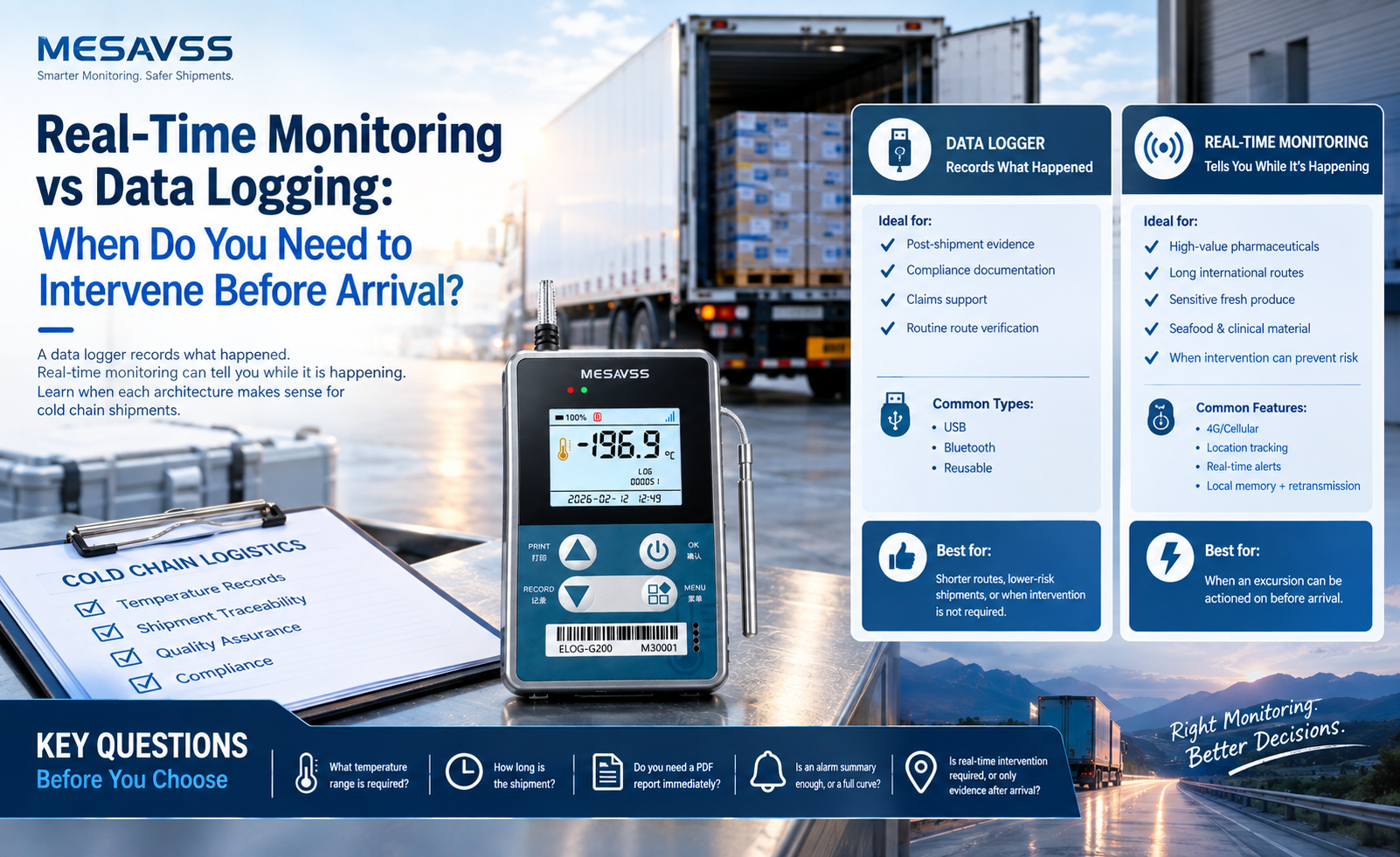
A data logger answers: 'What happened during the shipment?' A real-time monitoring device adds another question: 'Is there still time to do something about it?' Both can be valuable. The right choice depends on the consequence of an excursion and whether anyone can realistically intervene.
When a conventional data logger is enough
Standalone USB, Bluetooth or reusable loggers are well suited when the main requirement is post-shipment evidence, compliance documentation, claims support or routine route verification. They can be simple to deploy and do not depend on cellular coverage for data collection.
When real-time becomes valuable
Real-time monitoring matters when an abnormal condition can trigger an action before delivery. Examples include high-value pharmaceuticals, long international routes, sensitive fresh produce, seafood, clinical material or shipments where a refrigeration failure can be corrected if identified early.
Real-time does not eliminate local logging
A common misconception is that a connected device only needs the network. In practice, communication can be interrupted. Good architecture continues recording locally and uploads the missing records when the connection returns. The result should be both visibility now and a complete history later.
More data is not automatically better
Temperature, humidity, location, light, shock and tilt can all be useful, but only when they answer a real operational question. Adding sensors that nobody reviews creates complexity rather than control. Start with the risk: what event would change a decision? Then choose the parameters.
Think in terms of response capability
If an alert arrives at 2 a.m., who receives it? What is the response window? Can the driver safely check the unit? Can the route be changed? Can the receiver prepare an alternate handling plan? If the answer to all of these is 'no,' real-time may still provide visibility, but its intervention value is limited.
A practical selection rule
Choose a conventional logger when complete evidence after arrival is the primary need. Choose real-time monitoring when earlier knowledge can lead to a meaningful action. In both cases, prioritize data integrity, appropriate accuracy, calibration evidence and a workflow the operations team can actually follow.
Takeaway
The decision is not 'old technology versus new technology.' It is evidence versus evidence plus intervention. The right architecture matches the risk and the team's ability to respond.
Source notes for editorial verification
WHO - Temperature and humidity monitoring systems for transport operations