
ELPRO LIBERO CD Alternative: When Does a Probeless Dry Ice Logger Make Sense?
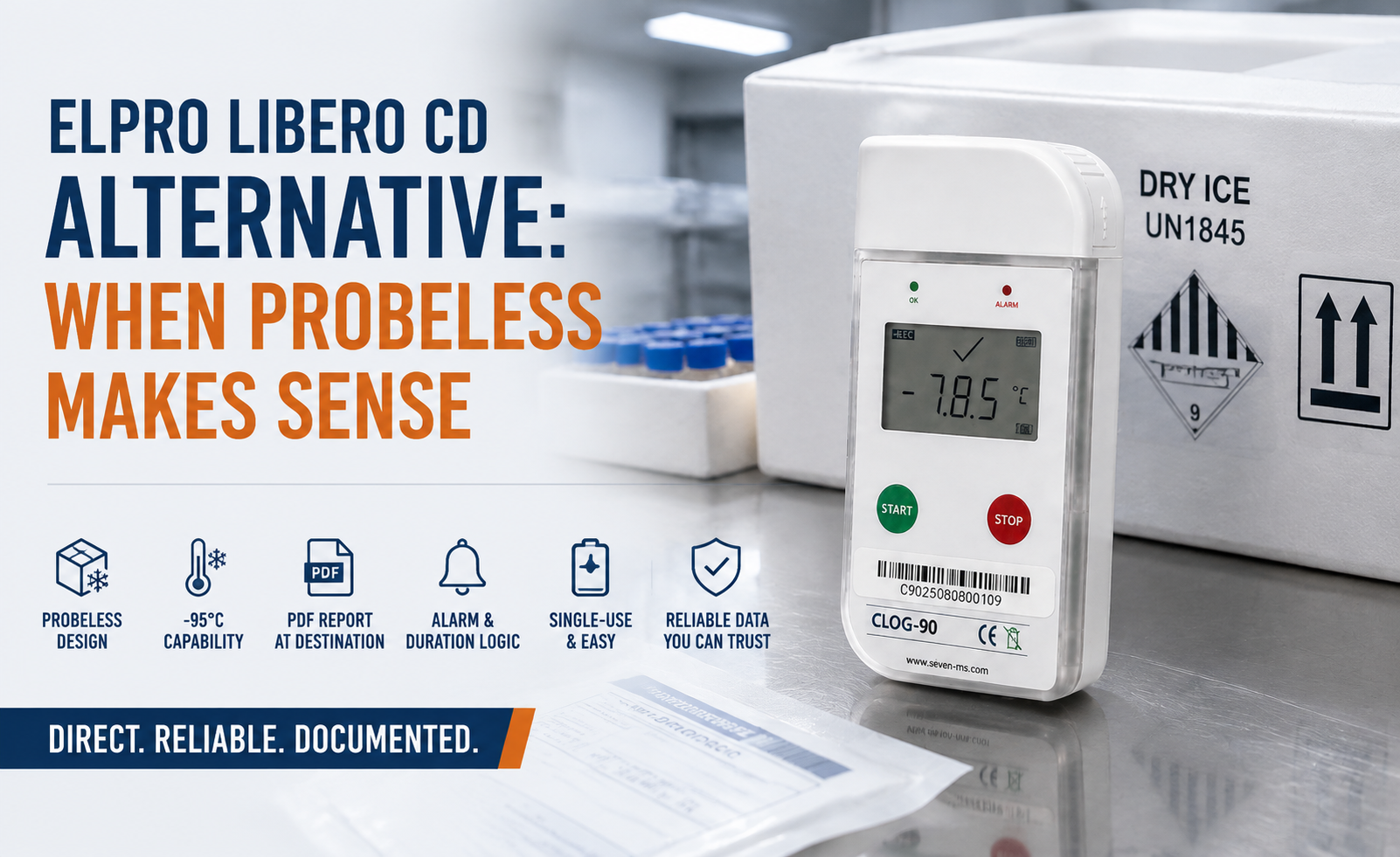
A dry ice logger without an external probe looks simple: put it in the box, start it, and read the record at the destination.
That simplicity is exactly why probeless loggers such as ELPRO LIBERO CD and MESAVSS CLOG-90 are useful. But “no probe” is not automatically the right design for every ultra-low-temperature shipment.
The best architecture depends on where you need to measure temperature, how the package is built, who handles the shipment, and what the receiver needs to do with the data.
What a probeless dry ice logger actually does
In a probeless design, the logger body and the temperature sensor enter the dry ice environment together. The device experiences the same general cold zone as the payload.
That removes the need to route a cable from an external probe to a logger outside the package. For one-way shipments, this can make pack-out faster and reduce installation variation between operators.
ELPRO LIBERO CD uses an internal sensor and is designed for direct dry ice placement. CLOG-90 follows the same general architecture and is specified down to -95°C.
When probeless makes sense: one-way shipments
If the logger travels with the product and is not expected to return, a compact single-use unit is often operationally clean.
There is no return loop, no need to recover a reusable device from the consignee, and no probe cable to manage. That can be attractive for international pharmaceutical shipments, clinical samples, biological materials and other high-value products moving between independent organizations.
When probeless makes sense: you want the logger near the payload
A probeless logger can be placed at a defined point inside the shipper, close to the product. That gives the quality team a record from the same internal environment rather than a reading from outside the insulation.
The benefit depends on placement discipline. If different operators place the device in different locations, the data can still be difficult to compare across shipments. The SOP should define the monitoring position just as clearly as it would define an external probe position.
When probeless makes sense: the receiver needs a simple report
USB-based probeless loggers are useful when the destination workflow is straightforward.
LIBERO CD can generate a PDF/A report and integrate with ELPRO's software tools. CLOG-90 is designed to generate an encrypted PDF through USB without a dedicated reader.
If the receiving team mainly needs to check alarm status, review the curve and file the shipment record, a self-contained report can keep the process simple.
When an external probe may be better
There are also good reasons not to put the entire logger into dry ice.
If staff need to see the display without opening the package, an external probe can keep the logger body accessible. If a reusable logger is part of the operating model, keeping the electronics outside the harshest environment may simplify retrieval and maintenance. If the temperature must be measured at a very specific point — for example inside a cryogenic vessel or an ultra-low freezer — a Pt100 probe can provide more flexible sensor placement.
External-probe systems can also support ranges well below conventional dry ice when the right probe is used.
The battery question matters more than many buyers expect
Ultra-low temperature is hard on batteries. ELPRO explicitly publishes service-life guidance for LIBERO CD at different exposure levels and warns that extended use below -80°C shortens battery life.
That is exactly the kind of information buyers should request from any supplier. A device may have a -95°C measuring limit, but the practical question is how long it can operate at the temperatures your lane actually produces.
For a five-day shipment and a 30-day shipment, the same lower-temperature specification may not lead to the same product decision.
What to compare when considering a LIBERO CD alternative
Use a qualification checklist instead of a brand comparison.
Confirm the lower measurement limit and accuracy by temperature band. Review battery/service-life guidance. Compare alarm configuration. Check what the display shows. Verify how the PDF is generated and protected. Review calibration traceability and any required standards. Confirm the device can be transported on your intended airline lanes.
Finally, test the pack-out. A logger can look perfect on paper and still create unnecessary work if it does not fit the physical packaging or receiving process.
Where CLOG-90 fits
CLOG-90 is relevant when the requirement is a single-use, probeless logger that can travel directly inside a dry ice shipment, provide local status on an LCD and generate a shipment PDF through USB. MESAVSS specifies the product down to -95°C.
That does not make it a universal replacement for LIBERO CD. ELPRO has a strong GxP-oriented software and validation ecosystem, and organizations already standardized on that system may have good reasons to stay with it.
The useful question is narrower: does CLOG-90 meet the user requirements for this shipment and this quality workflow? If yes, it can be evaluated as an alternative source.
The practical rule
Choose probeless when simplicity, direct placement and one-way handling are priorities. Choose an external probe when accessibility, precise sensor positioning or a reusable/extended-range architecture is more important.
The best dry ice logger is not the one with the most impressive datasheet. It is the one that fits the way your shipment is packed, handled, reviewed and released.
FAQ
What is the main advantage of a probeless dry ice logger?
It removes the external sensor cable and lets the complete logger travel inside the package near the payload.
When is an external probe better?
When the logger body must remain accessible, when precise sensor placement is needed, or when a reusable/cryogenic probe architecture is preferred.
Can CLOG-90 be considered as a LIBERO CD alternative?
Yes, for similar direct-placement dry ice use cases, subject to qualification against the user's accuracy, alarm, calibration, reporting and compliance requirements.
Why does battery guidance matter at -80°C and below?
Battery performance changes at ultra-low temperatures. The practical runtime at the coldest exposure may be more important than the headline minimum temperature.