
External Probe vs Probeless Dry Ice Logger: Which Is Better for -80°C Shipments?
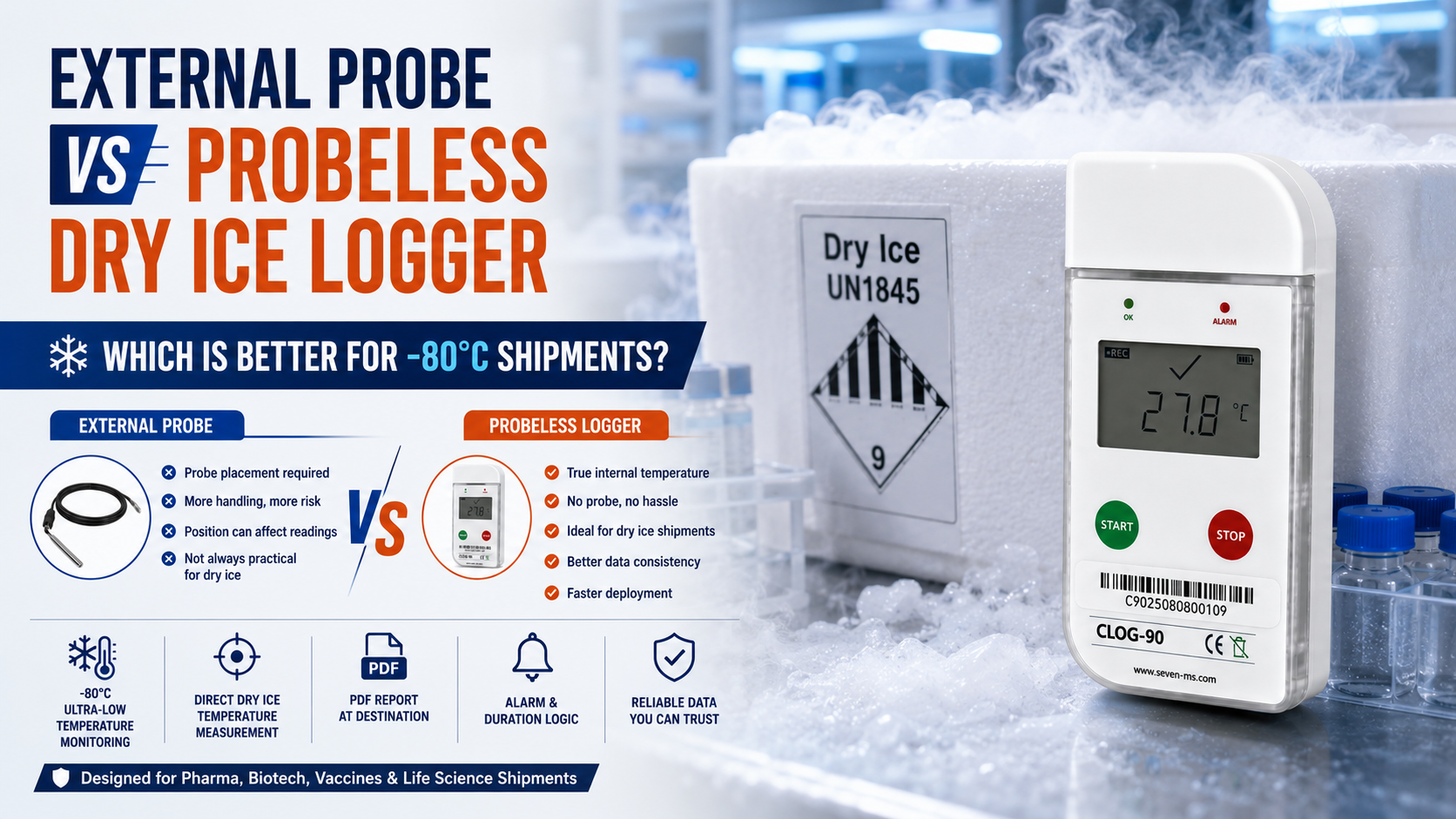
If a shipment is packed with dry ice, there are two basic ways to monitor it.
Put the entire logger inside the ultra-low-temperature package, or keep the logger body outside the harshest environment and place only a temperature probe inside.
Both approaches are used by established cold-chain suppliers. Sensitech, for example, offers both a Dry Ice Probe model and a Probeless Dry Ice model. That is a strong hint that the answer is not “one technology is better.” The right architecture depends on the shipment.
How a probeless logger works
A probeless logger has its temperature sensor inside the same device body that records and stores the data. The complete unit goes into the dry ice package.
Products such as MESAVSS CLOG-90, Sensitech TempTale Ultra Probeless Dry Ice and ELPRO LIBERO CD follow this general approach.
The benefit is simplicity. No probe cable has to cross the insulation, and the logger can travel next to the payload. For single-use shipments, the receiver can stop the unit and retrieve the report after arrival.
How an external-probe logger works
An external-probe design separates the sensing point from the logger body.
The probe enters the dry ice or ultra-low-temperature zone while the main electronics remain outside or in a milder part of the system. Sensitech explicitly warns that the body of its Dry Ice Probe monitor should not be placed directly into dry ice; only the probe is designed for that environment.
This architecture can protect the logger body from extreme cold and keep the display or controls accessible.
Probeless advantage: simpler pack-out
Every extra installation step is an opportunity for variation.
With a probeless device, an SOP can often be reduced to start the logger, confirm status, place it at a defined position and close the package.
There is no sensor cable to route, no concern about pinching the cable, and no need to decide where the logger body sits outside the cold zone.
That can be valuable at high-volume shipping sites or where different operators perform pack-out.
External-probe advantage: controlled sensor location
An external probe can be fixed at a precise point even when the logger body cannot physically fit there.
That is useful in ultra-low freezers, cryogenic containers, thermal chambers and some validated packaging configurations.
It can also make it easier to retrieve or inspect the logger without disturbing the payload.
Probeless trade-off: the electronics experience the cold
In a probeless logger, the battery, display and electronics all have to tolerate the ultra-low environment.
That is why battery/service-life data matters. The lowest measuring temperature alone does not tell you how long the device can stay at that temperature.
For longer lanes, qualify the full duration including possible customs or flight delays.
External-probe trade-off: more installation variables
A probe system introduces additional points of control.
Where is the probe tip? How is the cable secured? Does the cable route affect the thermal seal? Can the receiver accidentally pull the sensor out? Is the logger body protected during handling?
These are manageable issues, but they belong in the SOP and validation plan.
Which architecture gives the more representative temperature?
Neither by default.
A probeless logger next to the product can give a very useful picture of the internal shipper environment. An external probe can be positioned even closer to a critical location.
Representativeness comes from packaging qualification and repeatable placement, not from the word “probeless” or “probe.”
If the monitoring point has never been defined, changing devices will not fix the underlying uncertainty.
Which is better for typical -80°C dry ice shipments?
For one-way shipments where simplicity is important and the logger can remain inside the package until receipt, probeless is often a practical choice.
For reusable systems, applications requiring live access to the logger body, or installations where the sensor must be placed in a specific hard-to-reach point, an external probe can be better.
CLOG-90 fits the first category: a single-use, probeless USB logger specified by MESAVSS down to -95°C. MESAVSS SLOG-200E and ELOG-G200 represent external-probe architectures for other ultra-low applications.
A simple decision checklist
Choose probeless if you want a one-way device, simple pack-out, no cable and direct internal placement.
Choose an external probe if you need the logger body accessible, require a reusable device, need precise remote sensor placement, or operate at temperatures/conditions where the electronics should remain outside the coldest zone.
Then qualify the device in the actual packaging. Architecture is only the first decision; accuracy, alarm logic, runtime, report integrity and documentation still have to meet the user requirement.
FAQ
Can the body of every external-probe logger go into dry ice?
No. Follow the manufacturer's instructions. Sensitech, for example, states that only the probe of its Dry Ice Probe monitor is designed for the dry ice environment.
What is the main benefit of probeless?
Simpler installation: the whole logger goes inside the package with no external sensor cable.
What is the main benefit of an external probe?
The sensing point can be placed in the cold zone while the logger body remains accessible and protected.
Which is better for pharma?
Neither universally. The better choice depends on packaging, lane duration, access requirements, quality workflow and how the monitoring point was validated.