
MESAVSS CLOG-90 vs ELPRO LIBERO CD: Which Dry Ice Data Logger Fits Your Shipment?
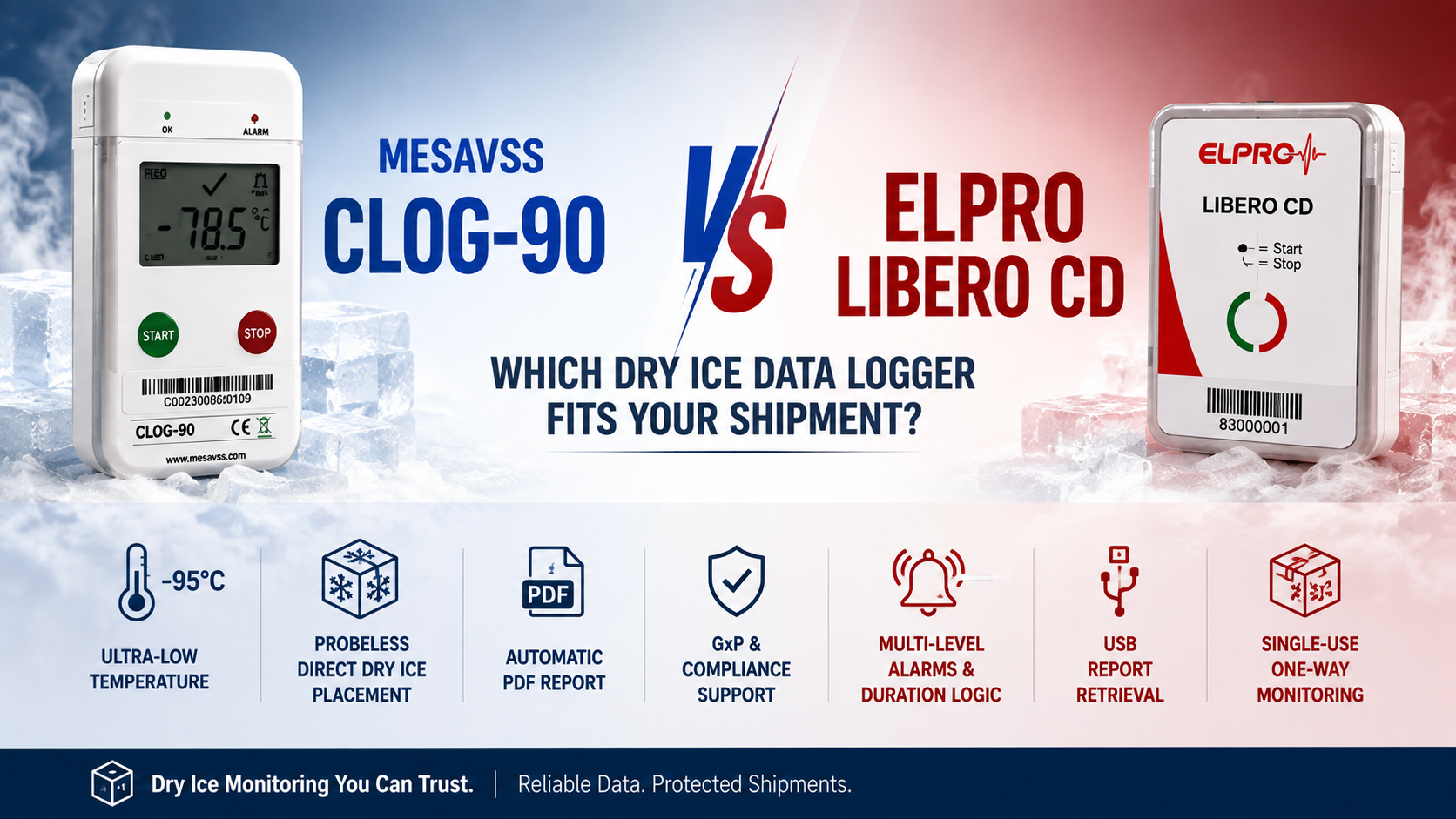
Dry ice data loggers are easy to compare poorly. A buyer sees “single-use,” “USB,” and “-95°C” on two datasheets and assumes the decision is mainly about price.
In real cold chain operations, that is rarely the whole story.
MESAVSS CLOG-90 and ELPRO LIBERO CD are both probeless, single-use loggers intended for deep-frozen and dry ice shipments. Both can travel inside the cold package and provide a report at destination. But they are built into different operating and quality ecosystems, and that difference matters to pharmaceutical and life sciences users.
Where the two products overlap
The common ground is clear. Both devices are designed to be placed directly into dry ice packaging, rather than keeping the logger outside the cold zone with an external probe. Both use an internal temperature sensor, both support USB-based report retrieval, and both are positioned for one-way transport monitoring.
CLOG-90 is specified down to -95°C and provides an LCD plus automatic encrypted PDF reporting through USB. ELPRO lists a measurement range of -95°C to +50°C for LIBERO CD, with an application range to -80°C and specific guidance for extended exposure below that point.
So if your initial question is, “Can these devices be used for dry ice monitoring?” the answer is yes. The useful comparison starts after that.
1. Do you need direct placement in dry ice?
For one-way shipments, probeless designs remove a surprisingly common source of complexity: the cable.
With an external probe, the shipper must decide where the probe sits, how the cable crosses the packaging, where the logger body remains accessible, and whether the setup affects insulation or handling. A probeless device reduces that setup to a much simpler instruction: place the logger at the defined monitoring point inside the package.
That simplicity is useful for high-volume shipping sites and lanes where different operators perform pack-out. It does not remove the need for a placement SOP, but it can reduce installation variation.
2. Look beyond the -95°C headline
ELPRO's technical specification is a good example of why buyers should read the details. LIBERO CD has a -95°C measurement limit, but ELPRO separately defines an application range and notes that prolonged exposure at the lowest temperatures affects battery service life.
That is a valuable purchasing lesson for any brand. Ask how long the logger is expected to remain at the coldest point, not only what minimum number appears in the brochure.
For CLOG-90, the same principle should be applied during qualification. Confirm the intended trip duration, expected temperature profile and the manufacturer's documented operating limits for your route.
3. Report requirements can decide the winner
CLOG-90 is designed to produce an encrypted PDF automatically after USB connection, without a dedicated reader. That is attractive when the receiver needs a straightforward shipment record that can be opened and archived quickly.
LIBERO CD also generates a built-in PDF/A report and is designed to work with ELPRO tools such as liberoCONFIG and liberoMANAGER. For organizations already using ELPRO for release workflows and cold-chain databases, that integration may be more important than any individual hardware difference.
A useful question is: what happens to the data after the logger is stopped? If the answer is “QA opens the PDF and files it with the shipment,” the workflow is one thing. If the answer is “the record must enter an established validated database and release process,” the requirements are different.
4. Alarm design should follow product stability
ELPRO documents multiple programmable alarm levels and duration logic. CLOG-90 supports multiple alarm ranges and provides alarm status on its display and report.
Do not choose based on which datasheet lists the bigger number of alarm options. Start with the product stability profile. If your excursion decision is based on cumulative time above a threshold, the logger must support and document that logic. If you only need a simple high/low warning, a more complex setup may add no value.
5. Calibration and compliance are not interchangeable words
ELPRO strongly positions LIBERO products around GxP workflows and publishes traceable production calibration information. It also documents standards and certifications for the LIBERO CD.
CLOG-90 has its own compliance and transport documentation, but buyers should still perform a document-by-document qualification for the intended use. Terms such as “calibrated,” “compliant,” “validated,” and “certified” do not mean the same thing.
For pharma procurement, the right comparison is the evidence package: calibration traceability, accuracy data, product specifications, transport safety documentation, software/report controls and the records required by your SOP.
6. When ELPRO LIBERO CD may be the better fit
LIBERO CD is a strong fit when a company already uses ELPRO's validated workflows, wants tight integration with liberoMANAGER, or has standardized quality procedures around the LIBERO family.
In that situation, switching devices can create qualification work that outweighs any hardware or price advantage. Consistency across the quality system has value.
7. When CLOG-90 may be worth evaluating
CLOG-90 becomes relevant when a shipper wants a single-use probeless dry ice logger with an on-device display, direct USB report generation and a simple one-way deployment model.
It can also be considered when a company is qualifying a second source, building an alternative supplier strategy, or wants to test a new logger on selected lanes before making a broader change.
The key is to treat the decision as a controlled qualification, not a brand swap.
Which one fits your shipment?
If your organization already depends on ELPRO's validated data ecosystem, LIBERO CD has an obvious workflow advantage. If your requirement is centered on direct dry ice placement, local trip status and portable USB reporting, CLOG-90 belongs in the evaluation set.
Both products illustrate the same bigger point: a dry ice logger is not just a sensor that survives low temperature. It is part of the evidence chain used to decide whether a temperature-sensitive shipment can be accepted, investigated, or released.
FAQ
Are CLOG-90 and LIBERO CD both probeless?
Yes. Both are designed around direct placement of the logger inside dry ice or deep-frozen packaging without an external temperature probe.
What is the lowest temperature?
MESAVSS specifies CLOG-90 down to -95°C. ELPRO lists a -95°C measurement range for LIBERO CD, with separate application and battery-life guidance for extended ultra-low exposure.
Does LIBERO CD offer a stronger pharma software ecosystem?
ELPRO provides established tools such as liberoCONFIG and liberoMANAGER and positions the product within GxP workflows. That can be important for companies already standardized on ELPRO.
Can CLOG-90 be evaluated as an ELPRO LIBERO CD alternative?
Yes, for similar probeless dry ice use cases, but the comparison should include documentation, alarms, calibration, reporting, and quality-system fit rather than assuming complete equivalence.