
Single-Use vs Reusable Temperature Data Loggers: Which Is Better?
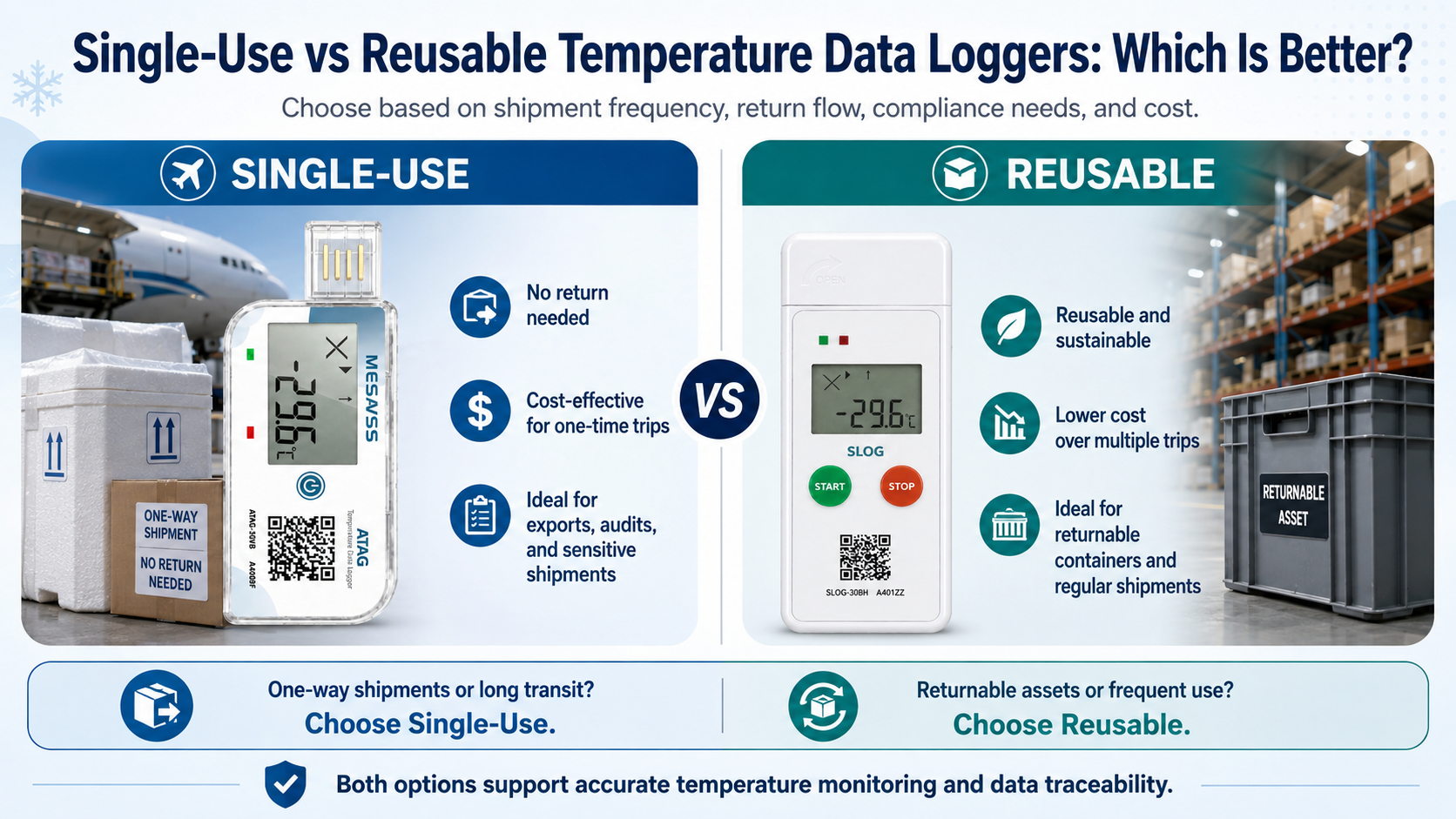
Neither single-use nor reusable temperature loggers are universally better. Single-use devices are usually stronger for one-way, multi-customer and international shipments because no device must return. Reusable devices are usually stronger in closed loops where retrieval, inspection, reconfiguration and calibration can be controlled. The correct comparison is total cost per successful trip, not purchase price per device.
The label “reusable” does not guarantee reuse
A reusable logger only creates value when it comes back. International freight, distributors and final customers often break the return loop. A low-cost single-use device may therefore be more economical than a reusable device that disappears after one journey.
The reverse is also true. In a stable route between two facilities, discarding a device after every trip can be unnecessarily expensive and wasteful. The operating model decides the answer.
What is a single-use temperature logger?
A single-use logger is activated for one monitoring cycle. It is typically preconfigured or configured before dispatch, travels with the cargo and generates a report at destination. USB models are common because the receiver can obtain a PDF without returning hardware.
Single use reduces return coordination, charging and redeployment. It also reduces the risk that an old device is sent again without the correct profile. However, disposal, battery waste and repeated purchasing must be considered.
What is a reusable temperature logger?
A reusable logger can be stopped, downloaded, reset and deployed for another trip. Depending on the model, it may use USB, Bluetooth or connected communications. It is well suited to internal transport, returnable packaging, rental pools, vehicles, warehouses and regular supplier-to-plant loops.
Reuse introduces responsibilities: device retrieval, cleaning, battery or charging control, functional checks, configuration, asset tracking and calibration management. If these tasks are informal, the apparent saving can disappear.
Side-by-side comparison
Single-use devices usually win on deployment simplicity, one-way shipment practicality and predictable handover. Reusable devices usually win on repeated closed-loop economics and the ability to standardise an owned device pool.
For calibration, neither category is automatically superior. The decisive questions are what evidence is supplied, how long it applies, whether the device remains within the organisation’s calibration programme and what happens after damage or extreme exposure.
Calculate cost per completed, usable trip
For single use, include device cost, programming, shipping stock, disposal and report handling. For reusable use, include purchase price divided by realistic successful cycles, return freight, loss rate, labour, charging, inspection, calibration, software and downtime.
Use realistic recovery, not ideal recovery. If a reusable device costs eight times as much but only half return, the theoretical break-even calculation is misleading. Likewise, if a single-use shipment repeatedly needs manual configuration or creates unreadable reports, its low hardware cost is not the total workflow cost.
Operational risk often decides before cost
A customer receiving hundreds of suppliers may prefer an automatic PDF device that requires no account or return label. A manufacturer moving material daily between two nearby plants may prefer a numbered reusable pool. A clinical shipment with strict chain-of-custody may use either, provided the monitoring record and controls meet the protocol.
Consider who starts the logger, who confirms activation, who stops it, who owns the file, and who acts on an alarm. If those responsibilities are unclear, changing device type will not repair the process.
Sustainability: count the whole system
Single-use devices create more discarded units. Reusable devices consume materials and energy too, and return transport can reduce their environmental advantage. A fair comparison considers device life, actual recovery, batteries, packaging, reverse logistics and any take-back or recycling programme.
Do not use “reusable” as a sustainability claim without operational evidence. Measure return rate, average completed cycles and loss or damage. Those numbers reveal whether reuse is occurring in practice.
When a mixed strategy is better
Many cold chains should not standardise on only one category. Single-use USB loggers can cover exports and irregular customer lanes. Reusable loggers can cover internal transfers, qualified routes and returnable containers. Real-time devices can be reserved for high-value or intervention-capable shipments.
A mixed policy is not inconsistency if selection rules are documented. It is risk-based deployment: match the monitoring cost and workflow to the consequence of failure.
MESAVSS options
MESAVSS ATAG and ILOG single-use models support one-way shipment monitoring and destination reporting. SLOG reusable models support repeated monitoring where devices can be recovered. Selection should also account for Bluetooth, humidity, measurement range and report requirements.
Before a volume purchase, compare both categories on the same route and receiving process. The better device is the one that consistently produces usable evidence with the least unmanaged work.